WAVES | Birth by Design

SECTION Three – What Birth Looks Like • CHAPTER 08
CONTENTS
Section Two – Understanding Labor
Section Three – What Birth Looks Like
Section Four – The Fourth Trimester
Assisted Delivery
The marathon of dilation is complete. Once your cervix is entirely open, the tone of labor fundamentally shifts. The uterus stops its work of pulling the cervix back and begins the active, expulsive work of pushing your baby down through the birth canal. The internal work of opening gives way to the outward work of birthing.
This is the second stage of labor. Here is an in-depth look at the mechanics, the physical sensations, and the exact steps of bringing your baby into the world.
Laboring Down: The Latent Phase of Pushing
Reaching 10 centimeters does not always mean you immediately begin pushing. Often, there is a transitional lull known as "laboring down" or the latent phase of the second stage. If the baby is still high in the pelvis, your care team may suggest resting for 1 to 2 hours, allowing the natural downward force of the uterine contractions to move the baby lower. This conserves your physical energy for when the baby is actually at the pelvic floor and ready to be born.
The Sensation of Descent
As your baby navigates the curves of your pelvis, their head presses directly against your pelvic floor and rectum. This physical descent applies pressure to stretch receptors, triggering the Ferguson reflex. The sensation is heavy, undeniable, and entirely consuming.
The Unmedicated Experience
Without an epidural, this deep pelvic pressure culminates in the Fetal Ejection Reflex—an involuntary, overwhelming physiological urge to bear down. Your body will likely begin to push on its own, much like the reflex to vomit, but directed powerfully downward. You will feel an intense need to bear down into your bottom, universally described as the sensation of needing to have the most massive bowel movement of your life. This is exactly what it is supposed to feel like; the baby is moving through the same physical space. Your vocalizations may deepen into low, primal grunts, and the sharp cramping pain of active labor often transforms into a distinctly productive, muscular effort.
The Medicated (Epidural) Experience
With a well-functioning epidural, the sharp, cramping pain of the contractions is muted, but the medication is typically dosed so you still feel the physical pressure of the baby’s descent. You will likely feel a deep, heavy ache in your pelvis, rectum, and lower back—often described as feeling like a bowling ball is resting on your pelvic floor.
This pressure is your anatomical guide. It tells you exactly where to focus your energy when it is time to push. If your epidural is particularly dense and you cannot feel this pressure, your care team will guide you, using the contraction monitor and physical touch (often pressing a finger just inside the vaginal opening) to tell you when and exactly where to direct your pushing efforts.
The Mechanics of the Push
As the baby descends, you will push during the peak of each contraction and rest completely between them. The baby moves down during the push and slips slightly back up when the contraction ends. This "two steps forward, one step back" motion is not a lack of progress; it is an intentional, protective physiological design. This steady back-and-forth gradually irons out and stretches your perineal tissue, preparing it to yield.
Crowning and the famous "Ring of Fire"
Eventually, the widest part of the baby's head emerges and remains visible at the vaginal opening between contractions. This is called crowning.
Because the perineal tissue is stretched to its absolute maximum capacity, it creates a sharp, highly localized burning, stretching, or stinging sensation universally known as the "ring of fire."
If you are unmedicated: This sensation is acute, hot, and intense. It is the peak sensory moment of the birth.
If you have an epidural: You may feel this intensely, mildly, or not at all, depending on how your specific block is sitting and how much medication is actively pumping through the catheter.
Navigating the Stretch
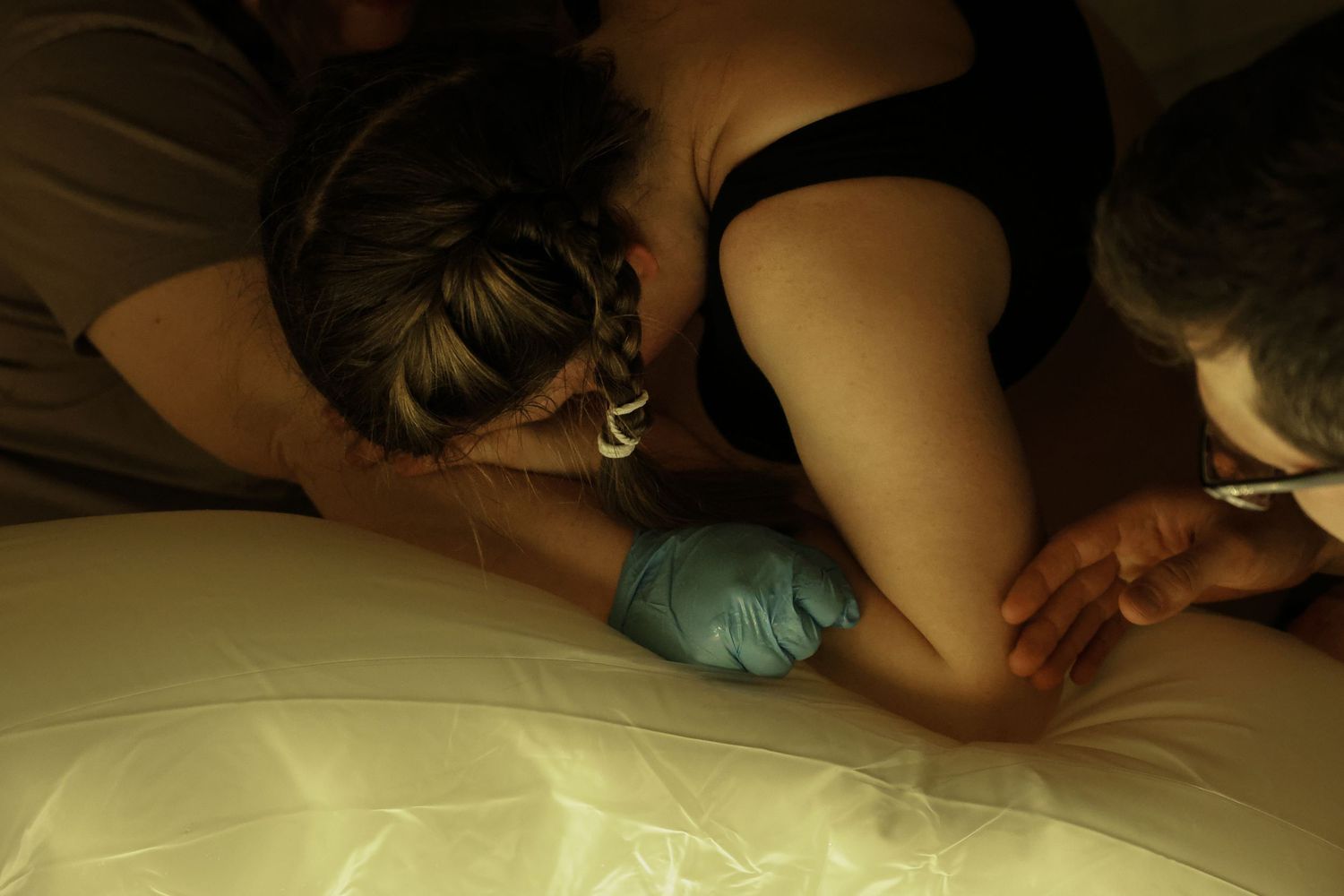
When you hit the ring of fire, your brain will instinctively tell you to panic, tense up, cross your legs, or pull away from the sensation. The work here is entirely counter-intuitive: you must lean into the heat and physically soften.
This is the exact moment to abandon forceful, breath-holding pushes. Instead, your provider will likely ask you to slow down or stop pushing entirely. You will switch to short, rhythmic pants (like blowing out a candle) or gentle, open-mouthed sighs.
The Jaw-Pelvis Connection: Dropping your chin and entirely relaxing your jaw directly translates to a relaxed pelvic floor. You cannot hold tension in your jaw and have a soft perineum.
Perineal Support: Your provider or doula may apply a warm, wet washcloth to your perineum to soothe the tissue and promote blood flow.
Breathing through this intense stinging, rather than pushing violently against it, gives your skin the necessary seconds to expand, significantly reducing the risk of severe tearing.
Restitution. Yes, there should be a short pause.
Once the head is born, the stinging typically subsides instantly, lots of moms have a brief yelp and then feel that relief of the widest part being out. There is almost always a brief, natural pause–that contraction has ended, baby's head is born, rest and be thankful. You will wait for the next contraction. If your provider tells you you need to deliver baby right this instant (for no medical reason, just because they want baby born), you can absolutely speak up and tell them to "Wait". During this pause, you will see the baby naturally turn their head to the side (restitution). They are internally rotating their shoulders to align with the widest part of your pelvis. Often, in hospitals providers are worried about a shoulder dystocia where the baby gets stuck with the shoulders/shoulder on the maternal pelvis, a lot of times, the providers want the baby to come out all at once so that they feel like there was no "getting stuck". Your baby is entitled to a pause, they have to turn, you can tell them to wait. If with the next following contractions the baby is truly in a dystocia, then there is validity, but immediately following the head, there will be a pause.
The Final Release
With the next contraction, you will give one or two final, guided pushes to deliver the top shoulder, followed by the bottom shoulder. Once the shoulders are free, the rest of the baby’s body slides out rapidly (and wetly) in a single motion.
Your baby is born!
The physical transition in this exact second is profound. The immense, all-consuming pelvic pressure vanishes instantly. The intense, muscular work of the second stage is immediately replaced by a feeling of complete physical emptiness, followed a split-second later by the sudden, heavy, wet warmth of your baby being placed directly onto your (hopefully) bare chest. Skin to skin should start immediately if baby is alert and mother is stable.
Typically, within 30 minutes, the placenta should follow, and you will no longer be pregnant!
NEXT CHAPTER – 05
Advocacy, Communication, + Decisions
This chapter covers the different phases and stages that you will experience during the birth of your child. Labor isn't just contractions all the time, nor are they the same the entire time through.
© 2026 Amie Bogart | Dove & Lioness Doula Services. All Rights Reserved
This educational course is written using established educational principles, reliable information sources, personal experiences and observations during births, common knowledge, and extensive self research. Birth is deeply nuanced and complex. Your individual birth experience may not be similar to the information, examples, or stories shared throughout this course, as every person's journey is unique. Everyone experiences labor differently, and what one person encounters may be entirely different from another's experience.